
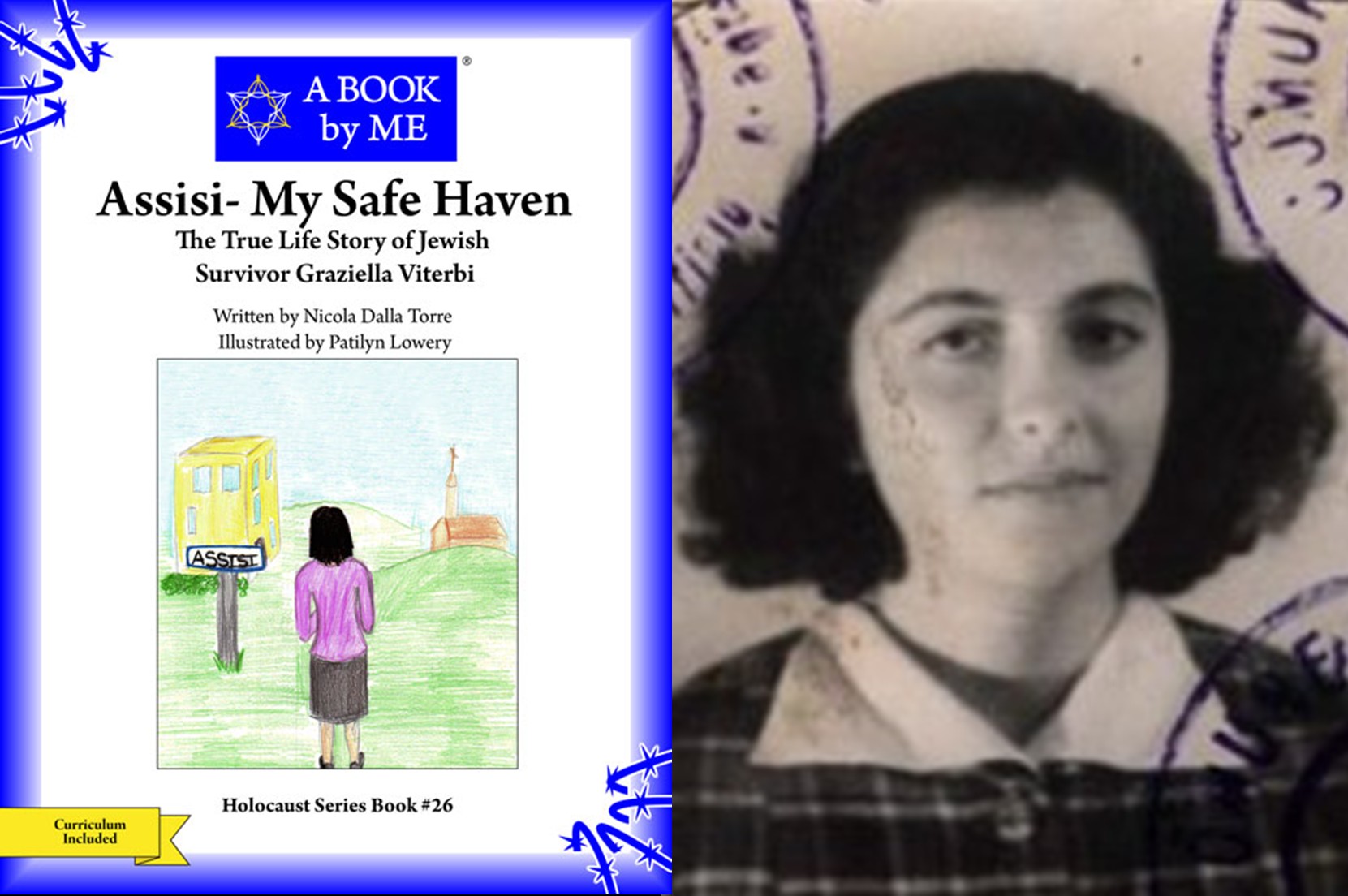
Assisi – My Safe Haven
The True Life Story of Jewish Survivor Graziella Viterbi
A BOOK by ME - True Stories Written by Kids for Kids
Written by Nicola Dalla Torre
Illustrated by Patilyn Lowery
Student exchange was a significant part of our family’s life while our three children were growing up. The young author of this book, Nicola, was our exchange son from Italy. When I introduced him to A BOOK by ME, I sensed a certain shame that his country was not aligned with the Allies. I believe he would have preferred for the people of Italy to be seen as the “good guys.”
One day, a woman I’d never met called to discuss the A BOOK by ME project. She had a relative at the Vatican and introduced me to an intriguing story that demonstrates the goodness of Italian people. We arranged to meet in person, and Nicola joined us so he could learn about it too. Together, we learned about an underground movement in Italy led by Bishop Placido Nicolini. A group of monks had devised a clever system for hiding Jews within the religious buildings of their city. Reports indicate that priests, printers, and a renowned cyclist helped save around 300 Jewish lives during WWII.
Gino Bartali, a legendary Italian cyclist and two-time Tour de France winner helped play a crucial role in saving approximately 800 Jews during the war. His efforts included acting as a courier for the Assisi underground network. He used his training rides as a cover to smuggle forged documents hidden in his bike frame between Florence and Assisi. When our son Nicola returned to Italy, he located a survivor named Graziella Viterbi. He interviewed her over the phone, and wrote her story. A talented young lady from Iowa illustrated the book. When I visited Nicola in Italy, we went together to meet Graziella in person. She had the honor of meeting with Pope Francis in 2016 to thank the Catholic Church for saving her life.
Deb Bowen, Executive Director Understanding Works
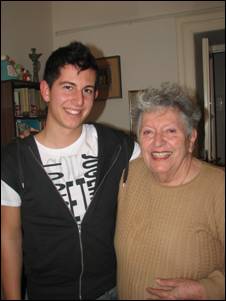
Author Nicola Dalla Torre with Graziella
Illustrator Patilyn Lowery
“This writing project was not just an assignment or just an interest of mine; it was an amazing life experience. It’s a gift from me to you on behalf of Graziella. Having her for a friend is something I’ll always remember.
I hope reading her story is something you will remember too. If you want to do something really cool in your life, become a young author or illustrator through A BOOK by ME. I’m glad I did and you will be too!”
Happy reading,
Nicola Dalla Torre
Graziella Viterbi – Jewish Holocaust Survivor
Graziella Viterbi was born on May 19, 1926 in Padova, a city in the northeastern part of Italy. She lived happily in a villa with her mother and father, studying with a private teacher during her elementary school years. At the age of six, she began to learn about Jewish culture and the Jewish festivals. A woman named Ada Levi, the wife of her family’s rabbi, was her teacher. During these early years, Graziella had many friends, both Jewish and Christian.
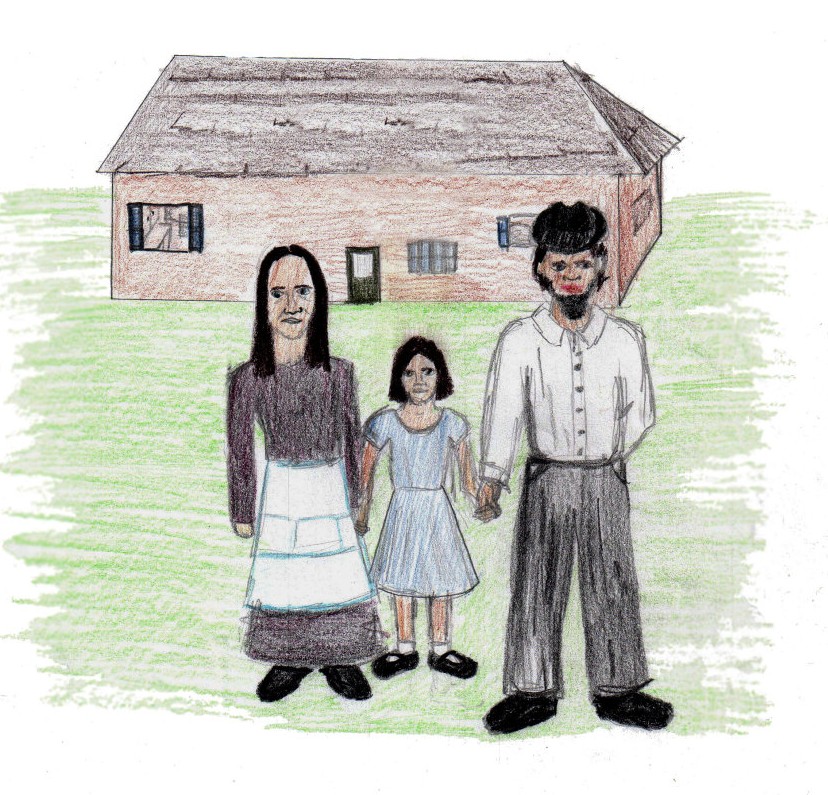
In 1933, when Graziella was seven, her little sister Miriam was born. Discrimination against the Jews began in Italy in 1938. Graziella was twelve, spending her holidays with her parents in Lido di Venezia, a famous Italian tourist destination. The newspapers reported that every Jew, whether student or teacher, was no longer welcome at the state schools. Graziella’s reaction to the new laws was really different from those of her friends and relatives. She thought, “They don’t want me? Well, I’m happy with the new way.” On the other hand, Miriam was five years old and felt the sting of the racial laws. Graziella’s younger sister didn’t have many friends, and she suffered from loneliness. The girls’ father, a professor at Padova’s university, was fired from his job because he was Jewish.
A year later, Lucia and Clara Levi, two Jewish sisters who were former teachers, decided to educate Jewish children at their home. Soon a villa in Pontecorvo was purchased so a proper Jewish school could be organized. Rabbi Augusto Levi was the school’s principal, and religion classes were taught in addition to the academic subjects.
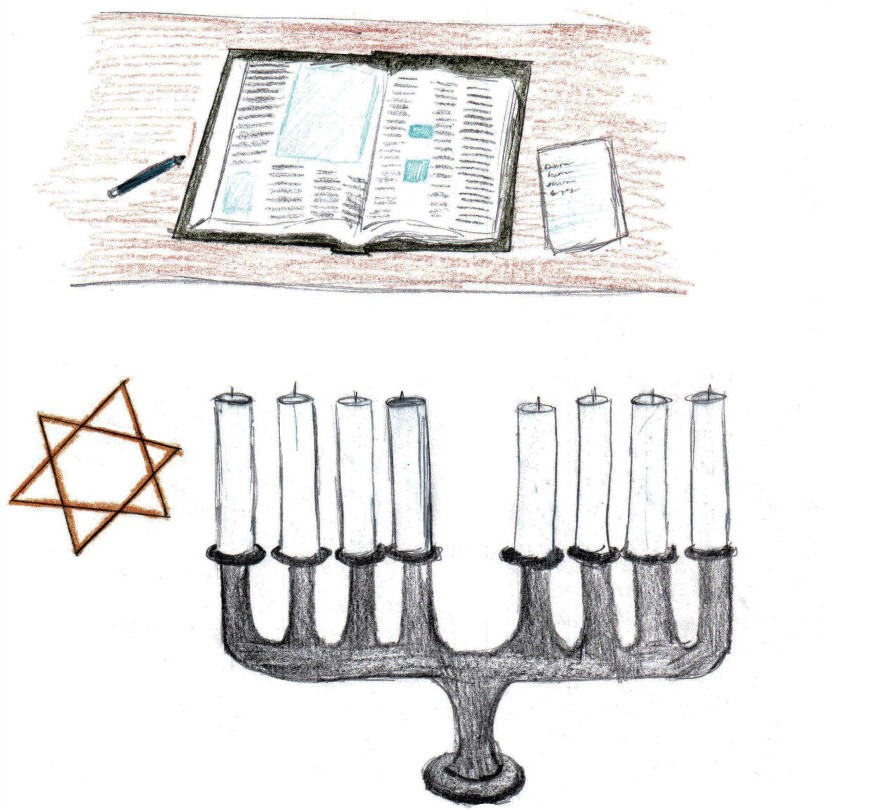
Persecution soon increased. There were intimidating phone calls and Jews walking alone at night were attacked and beaten. Some talked about leaving Europe. Members of Graziella’s father’s family were fortunate to take refuge in the United States.
During the summer of 1943, Graziella’s family was deciding where to go on vacation. The choices were few because of a list of places that the Jews were not allowed to travel. After checking the published list of forbidden locations, the family chose Porretta, in the province of Bologna. Their vacation was serene until the arrival of Nazi soldiers on September 8, 1943. Since most of the residents in the hotel were Jewish, the owner decided to move them to a nursing home in the mountains, hopeful they wouldn’t be found by the Nazis. The discussion moved to the possibility of going farther south in Italy, to Assisi. This city was considered a safe destination because it was far from the main road junctions, and a fantastic podestà (Italian name for “mayor”) governed the city.
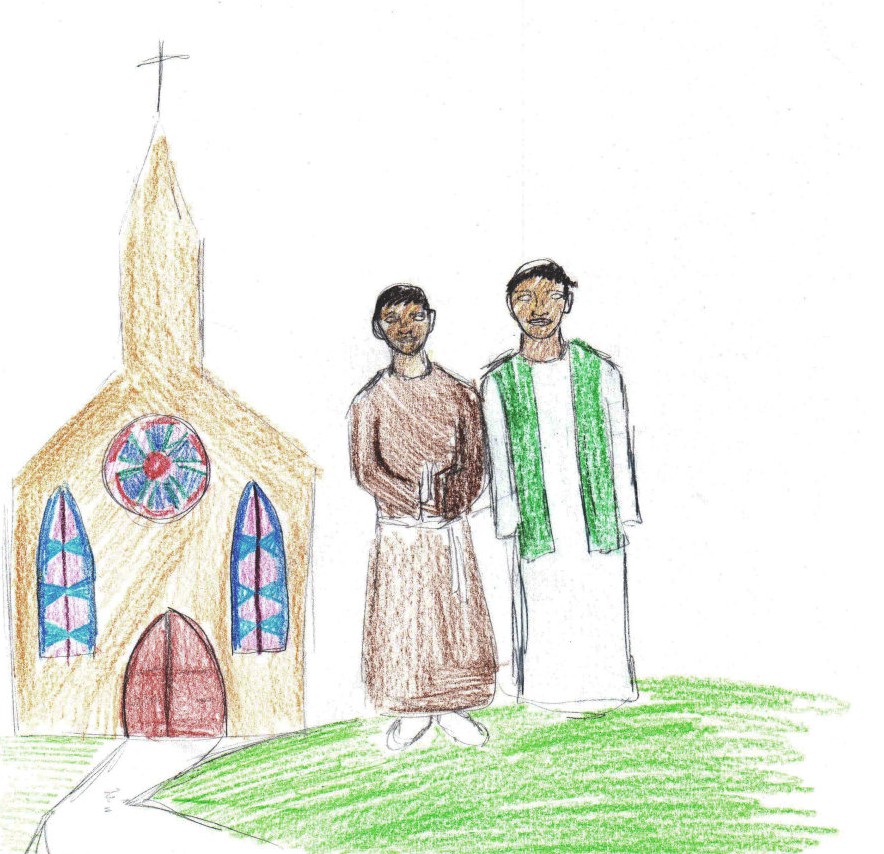
When asked, Graziella’s father told the German police that they were returning home to the south of Italy. They had obtained a car to reach Assisi, but halfway to their destination, the car broke down. Aside from these challenges, they successfully made it to Assisi without making the police suspicious. When they arrived, they looked for accommodations, but all the hotels were under Nazi control. They heard about an underground movement led by Bishop Placido Nicolini. It appeared the monks had a system of hiding Jews in the religious buildings of the city. They were able to supply Jews with false documents, so the Viterbis had new identity cards printed with their last name changed into “Varelli.”
Every single night, Graziella told her sister the story she had invented for their family. Their last name was Varelli and not Viterbis. They were from Lecce in southern Italy. Their anxiety about keeping their story straight grew when Graziella met a person from Lecce. She had to speak with a perfect local accent and remember the streets of the city. Fortunately, she had learned the location of the main buildings in the city thanks to a map they acquired during their stay.
One day, while questioning a couple of disguised Jews, the Gestapo found a tiny defect in the seal on their identity cards. Afterwards, the bishop feared for the Jewish families and decided to change all the identity cards already distributed. All last names were changed, so “Varelli” became “Vitelli”. The choice of the last name was fundamental. The first letter had to be the same as the real last name, so that if a Jew had been asked to sign a document, he or she would have time to make a correction if beginning to sign the real name.
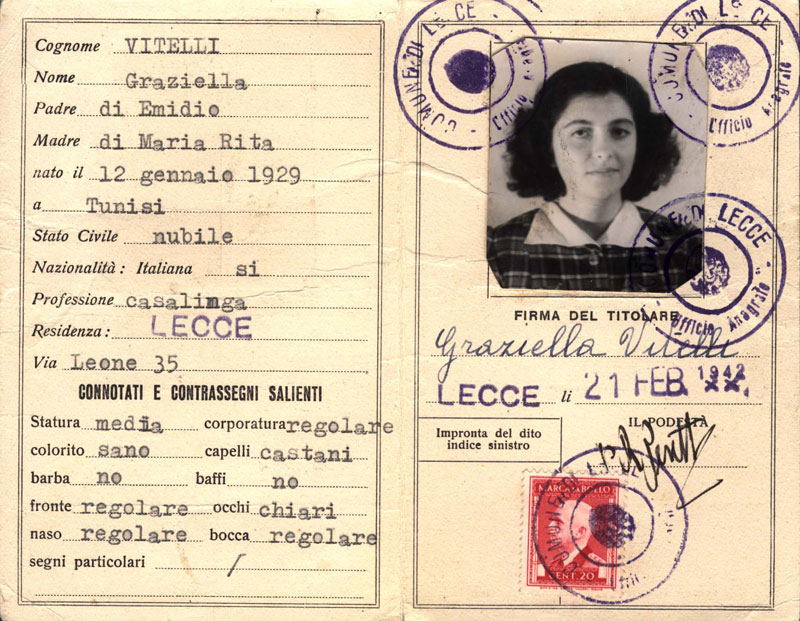
Graziella’s Identification Papers forged by Luigi Brizi and his son, Trento
The podestà Fortini was also helpful for the Viterbis. He proposed to bury some of their personal effects in his garden, so that there was no proof of their being Jewish if they were investigated. Later, when Fortini was asked by the Germans about the city he governed, he denied the presence of Jews hidden in the city.
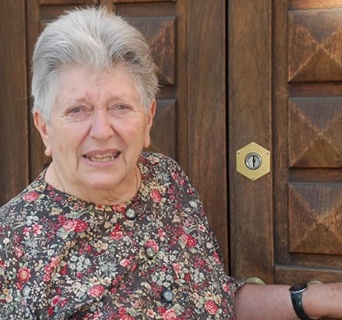
Graziella at the door where her family hid October 2013, Assisi, Italy
A German Colonel named Valentin Müller was assigned to occupy Assisi. He probably knew about the underground organization but turned a blind eye to the situation. He was part of the German army, but he was a good man and didn’t share the Nazi ideology.
When the Nazis planned to attack Assisi, Colonel Müller stopped the German troops from destroying the city. When he reported back to Germany, problems arose because of his actions. But he returned to Assisi where the mayor granted him honorary citizenship. When the Colonel died two years later, many olive tree branches were sent to decorate the grave of this noble man. The olive branches are the Christian symbol of charity and peace.
Following the repeal of the racial laws, Graziella’s father obtained a job as a teacher at Perugia’s university. The Viterbis stayed in Assisi for seven years, and then Graziella moved to Rome, where she studied law and sociology at the same university where her father taught. She became editor of a newspaper connected with an Israeli humanitarian organization. She also served as a social worker for Joint, an American organization assisting Jewish refugees from Eastern Europe.
Today, she is a retired widow and lives alone in Rome. Her two sons and four grandchildren, two girls and two boys, live nearby.
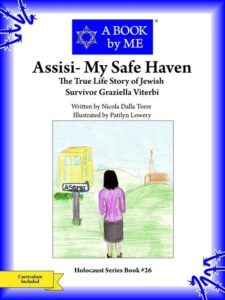 Assisi – My Safe Haven
A BOOK by ME, a book series developed by Deb Bowen, empowers students to preserve history by telling the story of unsung heroes in our communities. For the young participants, it’s a guided cross-curricular project that gathers stories of people who do amazing things but have received little or no recognition. Students learn how to publish a picture book that is a primary source document with photographs and a biography.
Since 2003, Deb Bowen has been arranging meetings between students and individuals from the WWII generation. This intergenerational storytelling results in unique storybooks written and illustrated by kids for kids in the A BOOK by ME series. More about Deb Bowen >